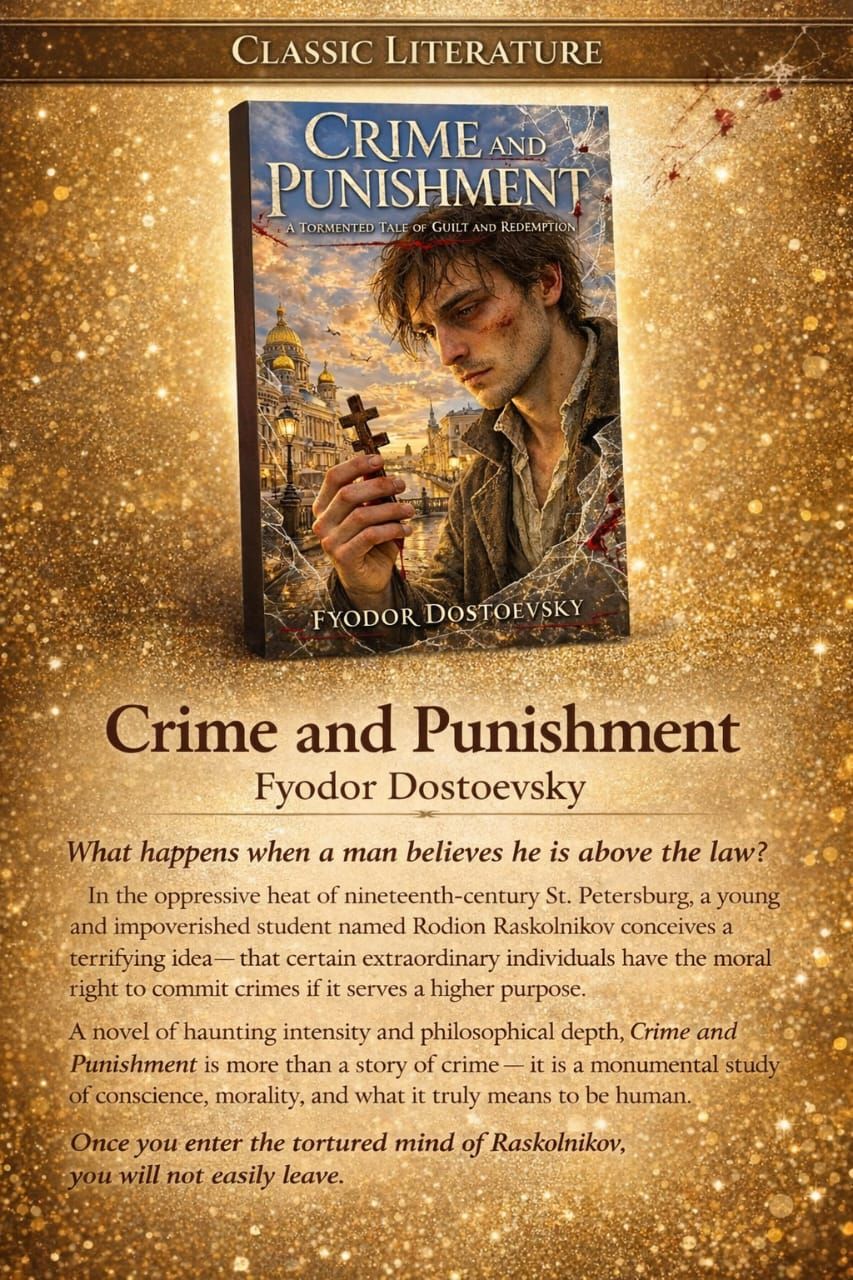
Upcoming Pick: Crime and Punishment. By Fyodor Dostoevsky
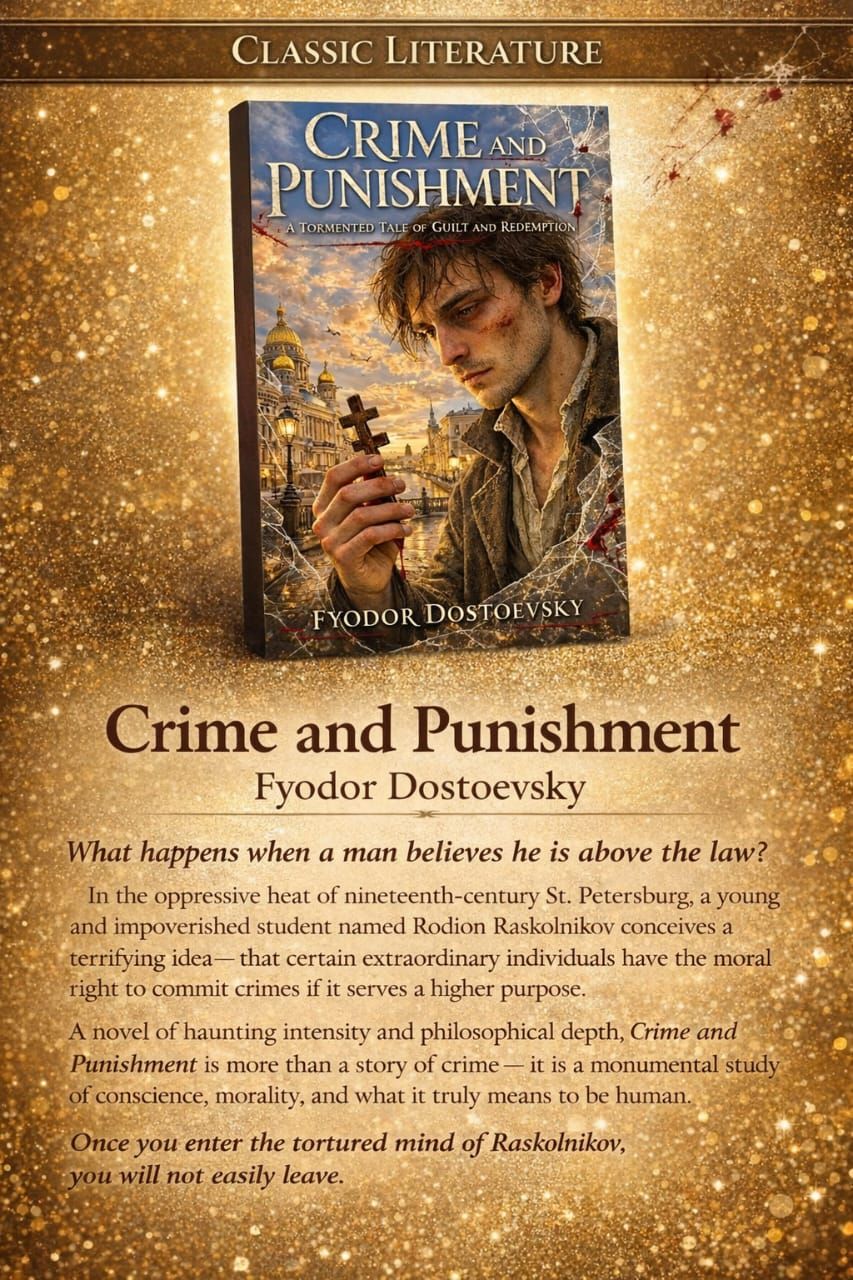
What happens when a man believes he is above the law? In the oppressive heat of nineteenth-century St. Petersburg, a young and impoverished student named Rodion Raskolnikov conceives a terrifying idea: that certain extraordinary individuals have the moral right to commit crimes if it serves a higher purpose. Driven by desperation, pride, and a feverish philosophy of superiority, he commits a brutal act that he believes will liberate him from poverty and prove his greatness. Instead, it shatters his mind. From that moment forward, Raskolnikov is plunged into a psychological nightmare of guilt, paranoia, and moral torment. As suspicion grows around him and his conscience begins to devour his soul, he finds himself caught in a relentless battle between intellect and morality, pride and redemption. Around him swirl unforgettable characters:
the compassionate Sonya, whose quiet faith offers the possibility of salvation;
The calculating investigator Porfiry Petrovich, whose probing mind slowly closes in;
and a gallery of desperate, tragic figures inhabiting the shadowy streets of St. Petersburg. In Crime and Punishment, Fyodor Dostoevsky created one of the most profound explorations of the human soul ever written. With astonishing psychological insight, the novel examines guilt, justice, free will, and the desperate search for redemption. The tension builds not through the mystery of the crime, which is revealed early, but through the agonizing inner trial that follows. Translated by Constance Garnett, whose elegant English rendering introduced generations of readers to Russian literature, this timeless masterpiece remains as gripping and disturbing today as when it first appeared in 1866. A novel of haunting intensity and philosophical depth, Crime and Punishment is more than a story of crime; it is a monumental study of conscience, morality, and what it truly means to be human. Once you enter the tortured mind of Raskolnikov, you will not easily leave.